Monday, February 24, 2025

Japan's Volcanic Activity past and present

Volcanic activity 

Japan sits on the Pacific Ring of Fire, making it one of the most volcanically active regions in the world. With over 100 active volcanoes, the country has experienced both devastating eruptions and continuous volcanic activity throughout its history.


A History of Volcanic Activity

Japan’s volcanic history is marked by significant eruptions that have shaped both the land and its people. One of the most well-known eruptions was that of Mount Fuji in 1707, known as the Hoei eruption. More recently, the 2014 eruption of Mount Ontake tragically claimed the lives of 63 people, highlighting the persistent danger posed by Japan’s volcanoes. Other notable eruptions include those of Mount Unzen in 1991, which resulted in pyroclastic flows that killed 43 people.

Current Monitoring and Warning Systems


As a result of its long history with volcanic activity, Japan has one of the most advanced volcano monitoring systems in the world, operated primarily by the Japan Meteorological Agency (JMA). The JMA works in collaboration with universities and research institutes to track seismic activity, gas emissions, and ground deformation, which can signal an impending eruption.


Mount Ontake Eruption in 2014

When Japan's Meteorological agency detects volcanic activity, the type of warnings that are broadcasted are dependent on the severity of the upcoming volcanic threat:

  1. Level 1 – Normal: No immediate danger, but monitoring continues.

  2. Level 2 – Restriction: Entry to the area around the crater is restricted.

  3. Level 3 – Avoidance: The public is advised to stay away from the volcano.

  4. Level 4 – Preparation to Evacuate: Local authorities prepare for potential evacuations.

  5. Level 5 – Evacuation: Immediate evacuation is required due to imminent eruption.


Once the severity of the volcanic threat is determined, warnings are then communicated through emergency alerts, media broadcasts, and local government channels to ensure citizens are promptly informed of the incoming threat.


Tuesday, February 11, 2025

Japan's Seismic Activity

Being located on the Pacific Ring of Fire, Japan is one of the most seismically active countries on Earth. The island nation experiences thousands of earthquakes annually, with some of them reaching devastating magnitudes. Historically, Japan has suffered some of the world’s most destructive earthquakes, such as the Great Kanto Earthquake of 1923 and the Tōhoku Earthquake of 2011, which triggered a massive tsunami and led to the Fukushima nuclear disaster. 


Preparedness and Prevention

Because of its vulnerability to seismic activity, Japan has implemented various measures to enhance preparedness and prevent future earthquake disasters. These measures include:

1. Advanced Building Codes

One of the most effective measures Japan has taken is the implementation of strict building codes designed to withstand seismic activity. These regulations require buildings to have earthquake-resistant structures, such as shock absorbers, base isolators, and flexible frameworks that allow buildings to sway rather than collapse during an earthquake. High-rise buildings are specifically designed to endure strong tremors, ensuring the safety of occupants.


2. Early Warning Systems

Image from Japan phasing in its quake warning system

Japan has one of the most advanced earthquakes early warnings (EEW) systems in the world. The system detects seismic waves and provides alerts via smartphones, television, radio, and public announcements, giving people valuable seconds to take cover before the shaking begins. This warning system has saved countless lives by allowing individuals and businesses to prepare for incoming tremors.


3. Disaster Drills and Public Education

Regular disaster drills are a cornerstone of Japan’s earthquake preparedness. Schools, businesses, and local governments conduct routine emergency drills to ensure that people know how to respond during an earthquake. Public awareness campaigns educate citizens on securing furniture, identifying safe evacuation routes, and assembling emergency kits with food, water, and medical supplies.


4. Tsunami Defense Mechanisms

Since many earthquakes in Japan trigger tsunamis, the country has developed an extensive tsunami defense system. Coastal regions are protected by seawalls, floodgates, and elevated evacuation centers. The Japan Meteorological Agency provides real-time tsunami warnings, allowing coastal communities to evacuate swiftly.


5. Technological Innovations

Japan continuously invests in seismic research and technology to improve disaster response. Innovations such as smart sensors, AI-based earthquake predictions, and underground shock-absorbing materials are being developed to enhance safety. The use of satellite monitoring also helps in tracking seismic activity and providing data for better forecasting.


Sources


“How Does Japan Protect against Earthquakes?” Japan Nihon, 9 Mar. 2023, www.japannihon.com/how-does-japan-protect-against-earthquakes/.

“Japan Spent Decades Making Itself Earthquake Resilient. Here’s How.” PrepareCenter, 5 Jan. 2024, preparecenter.org/story/japan-spent-decades-making-itself-earthquake-resilient/.

 Live Science. “Japan’s Biggest Earthquakes.” LiveScience, Purch, 8 Apr. 2011, www.livescience.com/30312-japan-earthquakes-top-10-110408.html.

Lim, Seunghoo, and Hiromi Nakazato. “Co‐evolving Supportive Networks and Perceived Community Resilience across Disaster‐damaged Areas after the Great East Japan Earthquake: Selection, Influence, or Both?” Journal of Contingencies & Crisis Management, vol. 27, no. 2, June 2019, pp. 116–29. EBSCOhost, https://doi-org.mpc.idm.oclc.org/10.1111/1468-5973.12244.


Tanaka, Shigeyoshi. “The 2011 Great East Japan Earthquake and Tsunami: The Highest Casualties and Largest Reconstruction Funds—Characteristics of Major Disasters and Future Challenges in Developed Countries.” Japanese Journal of Sociology, vol. 32, no. 1, Mar. 2023, pp. 7–24. EBSCOhost, https://doi-org.mpc.idm.oclc.org/10.1111/ijjs.12147.

Tuesday, February 4, 2025

Tectonic Plates and Boundaries

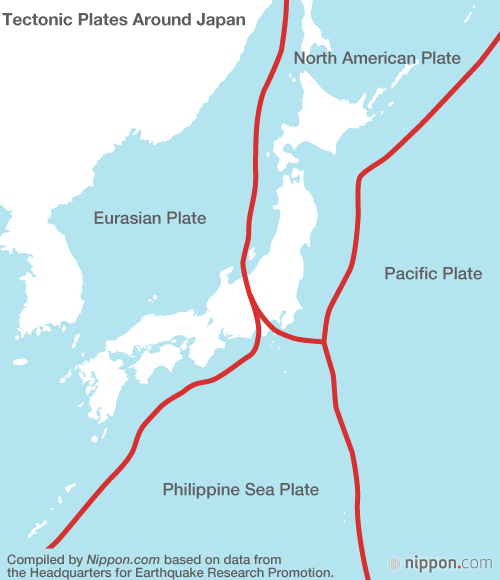
Due to its unique geographic position, Japan is one of the most geologically dynamic regions on Earth. It lies at the western portion of the ring of fire while also being in the middle of an intersection of four major tectonic plates: the Pacific Plate, the Philippine Sea Plate, the Eurasian (Amurian) Plate, and the North American (Okhotsk) Plate.

These plates form a tectonic boundary known as a subduction zone meaning that the tectonic plates in this area force one plate under another. This constant interaction between tectonic plates, colliding, and grinding against one another, creates an environment prone to significant geological activity. The movement of these plates are responsible for shaping Japan’s dramatic landscapes, from its towering mountain ranges to its deep ocean trenches.

Additionally, this relentless tectonic activity is the driving force behind the country’s frequent earthquakes, tsunamis, and volcanic eruptions, making Japan a global hotspot for seismic and volcanic activity.


Photo from: The Next Big One: Government Map Forecasts Likely Future Japanese Earthquakes | Nippon.com


Sources:   

Japan's Greatest Natural Hazard's

  Japan is a beautiful country known for its amazing culture, technology, and nature. But it is also one of the most active places in the wo...